Episode 199 - Getting Real About Slowing Down
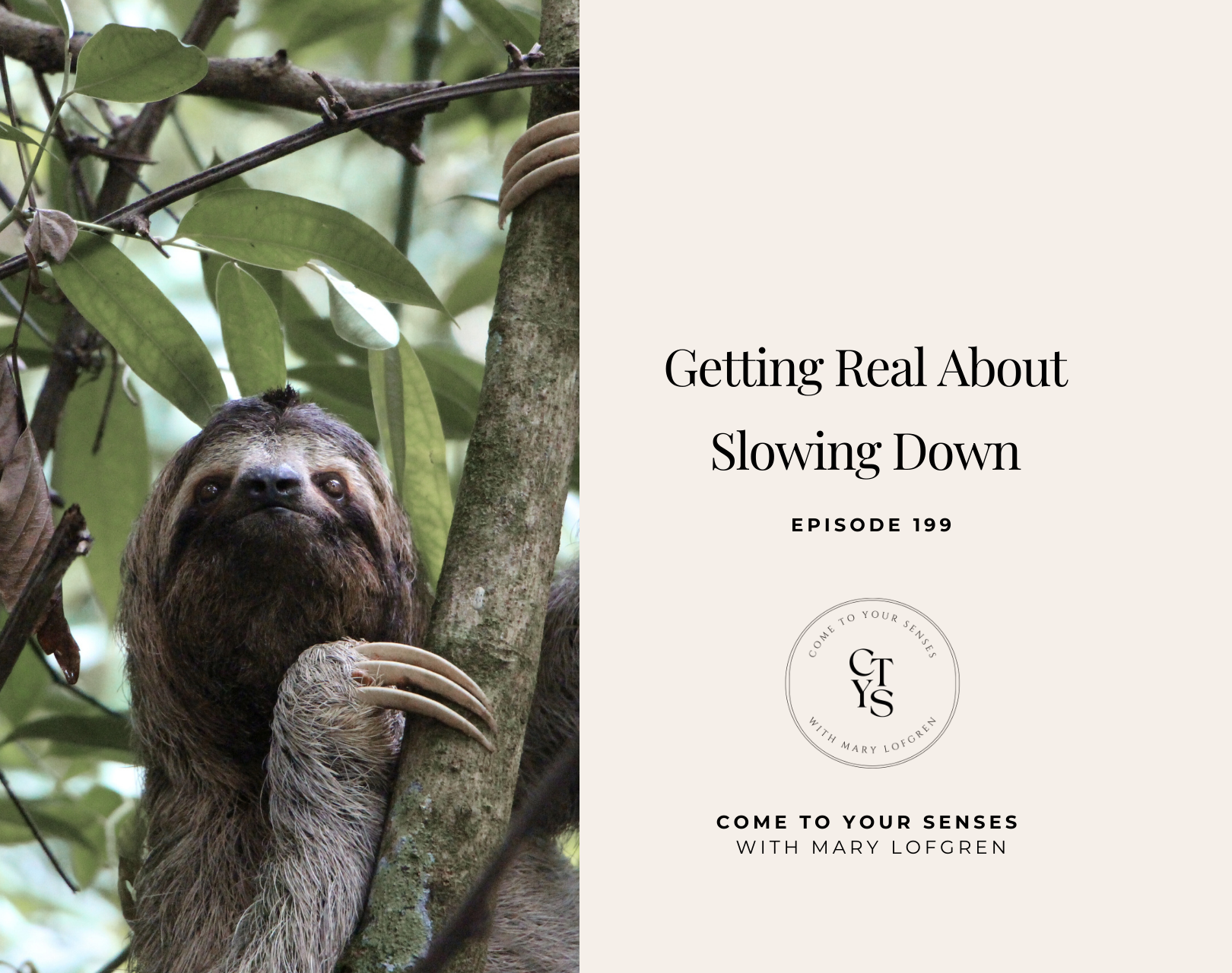


Does it ever annoy you when people tell you you need to slow down?
Especially when there’s so much to do, and so much you want to do, slowing down can feel like the last thing you need.
Or maybe you crave a more intentional pace, but feel like you need to turn your life into Pinterest perfection.
Today’s episode explores what slowing down actually means in the body.
Think less retreating from life, more feeling safe enough to actually inhabit it.
We explore:
Why “just relax” isn’t helpful advice
What you’re really seeking when you want to slow down, and a more honest way to get there
Three luxurious ways to tend your feminine nervous system
Make like a sloth and climb on in.
Themes
slowing down, nervous system regulation, feminine nervous system, presence practice, how to relax, stress relief for women, somatic healing, polyvagal theory for beginners
Links from the show
Anchored by Deb Dana
Leave a review of the Podcast
-
Hello beautiful and welcome to the Come to Your Senses podcast. I'm your host award winning certified feminine embodiment coach, licensed esthetician, and enthusiastic foster dog mama to animals across the land. Mary Lofgren. Here we explore how to bring more richness, radiance, peace, and pleasure to our lives, homes and hearts through the joy of beauty, the wisdom of the body, the warmth of connection, and the splendor of the senses. I'm so glad you're here. Pull up a pouf and let's dive in. Hello beautiful beings, and welcome to today's episode, which is all about this elusive, often unattainable feeling yet deeply desired state that we call slowing down. When I work with clients, either in my membership, the sanctuary, or one on one. You know, there's always this feeling of skidding through life. And we talk about a lot of different things here and come to your senses, everything from mindfulness to mascara, from somatic healing to sensuality. But what's really at the heart of all of it is a quality of presence, this experience of really feeling like we are in our own lives and not just present as in aware of what's happening, but awake to our own aliveness. And today we're going to explore how to slow down ways that you can slow down, that don't require for you to take a hacksaw to your life. Current structure. And that helped to bring a little bit more clarity to what it is that we're saying we want. When we say slow down, because slowing down is relative to what it's being compared to. And when we move at a state of hyper efficiency and hyper productivity, what we are wanting in replacement of that is a slower pace. But what we're really talking about is moving at the pace of our own presence, moving at the pace of our own aliveness, and dancing in that beautiful balance between spaciousness and fullness. The thrill of healthy risk and the satisfaction of healthy rest. And if we imagine a skeleton key that can unlock the door to this state of balance between presence is the key. And so and so, I drop and bestow that key into your open palm. And let us now open this treasure box of gems awaiting us today. And so where we begin is by bringing a little bit more of a shape to what it is we mean when we say slow down. And so some words that might resonate. And I invite you to just see how these land in your body, when we think about this energy of slowing down is softening, being relaxed, a state of ease, unwinding, lingering and taking your time, and so noticing just how those words land in your body. Because for some of you, they might feel like a glittering oasis in a scathing hot desert. For some of you, they might feel like a gross too soft. I need something that will kind of pull me out of my doldrums, you know, depending on where you are in your life and depending on where you are in your day and. Typically when we talk about slowing down, what we're really talking about is moving from a state of sympathetic nervous system response. So fight or flight to a state of ventral vagal nervous system response, which is the state in which our nervous system feels safe. We're regulated. We're able to connect either with other people or connect with the world around us. We're not in the tunnel vision and the trance of fight or flight. And that's an important piece to name. Is that one of the synonyms that I would use for this state, called slowing down, is simply a state of safety. And safety may not sound very fancy or luxurious, but safety is the very foundation from which we can actually experience all these states that do sound a little more sexy, like softening and lingering and enjoying and experiencing. And to better explain this a little bit, I want to share with you a little bit about the branches of the nervous system and how we arrive at this state that we called slowed down or relaxed. And I want to give some appreciation to my good friend Rochelle Chic, who is the founder of Koya inspired movement. I'll put a link to that in the chat or in the, uh, space below this episode, the show notes, because lately I've been dancing with Rochelle in the morning through her membership community, which is called Law Lifestyle of Reverence every day, where she teaches a daily Coya session. And we've been exploring this beautiful book by Deb Dana called anchored that is all about how to better understand the branches of your nervous system, and particularly your system of connectivity through something called poly vagal theory. And. If those are like overwhelming words and terms, you can just toss them in the bin because I'm going to just explain them in a simplified way. Now, when we are in a state where we're not present, we are in hyper acceleration. You know, I'm sure you can relate to waking up in the morning feeling like you're already in motion. Feeling like your to do list is the first thing to occur to you before your own aliveness. And maybe in response to that, you feel frustrated, which might accelerate that feeling of hyperactivity. Or you might shame yourself like, what's wrong with you? That you're not more relaxed, that you're not at a different station in your life where you could be more relaxed, blah, blah, blah, which might cause you to shut down. And in response to that, your system as a very loving and beautiful method of protection will reach for something that provides regulation. In an ideal world, you might reach for your yoga mat and hook into a law session or join us in the Come to Your Senses sanctuary, where we explore presents from a feminine perspective. But in a not so ideal picture, you reach for your phone, or you reach for that extra cup of coffee, or you go and do some action that will help to regulate, as in de intensify that current state of either acceleration or shutdown. And. Something like going into a choir class or a guided meditation with other like hearted folks is going to help your nervous system regulate at a pace where it can gently come down into a state of regulation. However, in those moments of intensity, we might be more likely to seek something that gives a more immediate sense of relief, like jumping into total oblivion through opening social media. The downside of that approach is that you then end up flip flopping between oblivion and intensity and oblivion in intensity, which only makes each state more potent and only makes regulation a little more challenging to arrive at. So, for example, when I get into bed at night, if I've taken care of and tended my nervous system throughout the day, I'm usually getting into bed with. Generally life affirming thoughts. You know, like, oh my sheets. I'm excited to Nestle in. I'm excited for sleep. Whereas if I haven't really tended my nervous system, or I've been reaching for those moments of escape all day, I like to call it putting on the ring. Like when I open social media and I get flipping and scrolling, I feel like Frodo and Lord of the rings where he puts on the ring and he just disappears. Like, I'm able to actually be in my life. Like I'm aware that I'm there in a body, but my consciousness is so absorbed in something else that I don't actually have to experience my life. And so when I get into bed on those nights, I feel a little bit more like a cartoon that just stepped on a rake, and it's like, Bing! And I need to do like some deep, intensifying practices that help bring me back to baseline. However, the farther away I am from baseline, the longer a journey it is to get back. And this is why, you know, in the sanctuary, which is again a community that's devoted to practices to arrive at presence that are specifically designed to meet the needs of the feminine nervous system. All of our practices, all of our charms in the library, which are just little tiny servings of presence practice that you can do any time. All of our live gatherings, they happen like a sliver of cake. You know, you're not trying to shove the whole thing in your mouth at once. You're not depriving yourself. You're giving yourself just that delicious, satisfying, rich taste. And then you're done. And you can push the plate away, and you can go on to the rest of your life. And so certainly maintaining your nervous system throughout the day is ideal. And sometimes you might just have to walk a more winding path to get back to center. And yet. This state of ventral vagal regulation, this campfire of calm, this ability to stay within yourself while also connecting with others, connecting with the world around you. Connecting with spirit is something that is inside of you always. And today at our law practice, we read a quote from Albert Camus that says, in the midst of winter, I found there was within me an invincible summer. And there are a lot of practices out there for nervous system regulation. I mean, it's honestly quite overwhelming sometimes it's funny because the nervous system is best able to process things in small doses and in small bites, and gradually grow and expand, just like our bodies when I digest food. And sometimes when I'm looking at all of the information that's out there and all the books that have popped up, which is so wonderful, I mean, I hold a vision that this stuff is taught in first grade and, you know, throughout a child's development because, gosh, our nervous system, I mean, the thing that we call our sense of self, our thoughts, our digestion, our sleep patterns, everything about us is in some way an expression of the state our nervous system is in at that time. And an example of this might be, you know. When you're pissed at your spouse and you see their nose hairs and you're like, God, you vile creature. And then they do something really sweet and you see their nose hairs and you're like, oh God, you're such a cute little bear. You know what I mean? Like, all of that has to do with nervous system regulation. And this is our first gym. It's a big, fat, glimmering one is a bit of understanding that when we talk about slowing down, what we're really talking about is an embodied state of safety where we don't have to run through fight or flight. We don't have to numb through this branch called dorsal vagal or shut down. We can really be here. And our next gem is a gem around how do we walk that path from these states of activation or shutdown back to our center? And here is where I feel it is incredibly important to name the distinctions between the nervous system that we call masculine and the nervous system that we call feminine. And it may surprise you, although maybe not that the feminine nervous system was not really studied until the 1990s. And the reason is because the hormonal fluctuations of a menstruating person's menstrual cycle was considered air quotes a confounding variable, and so nervous system regulation and nervous system information was all based on this masculine template, which is a completely different set of cards to the nervous system that we call feminine. And I say the nervous system we call feminine because our nervous systems orientation is fluid, and we all contain these masculine and feminine spectrums within ourselves, as well as multitudes of other spectrums. In your nervous system, you may relate to having some attributes that resonate more with the side of the spectrum that we call masculine, and you might have a nervous system that resonates more with the attributes of what we call feminine. And lordy gee. To quote my friend Roderick Covington, I could really spill the beans on the feminine nervous system in big and beautiful ways. And I intend to coming down the. Garden Path. In the next couple of weeks. I plan to be expanding these teachings here on the podcast, but also sharing them in some additional resources that you can go more in-depth into. So stay tuned about that. And here I want to share with you some of the ways that the feminine nervous system finds regulation in ways that often aren't talked about in traditional nervous system regulation, communities or education. So, for example, you might know that if you want to slow down and relax, you might start a meditation practice. However, if your nervous system is of the feminine variety is of this confounding variable, you may find that seated meditation actually enhances and accelerates your stress response Because it enables and strengthens the part of you that has learned how to override your instincts by being socialized as a woman. You might know that hot baths and self-care and beauty treatments and all the rest are lovely ways to care for yourself and tend your nervous system. And they are. But if they're not balanced by nourishing relationships and genuine connections, you might feel like you are in a self-care vacuum. Or no matter how much sleep you get, no matter how much care you give yourself as an individual, you're still tired and you're still bracing because the feminine nervous system finds regulation through intimate, genuine connection where we feel not just heard, but met. Okay. This is why. When I was in my teens, my friend Jonathan and I would play the game Girl talk. Okay. Have you ever played the Game Girl talk and you had your zit stickers? Or you take a call from your best friend and you guys gab for like two hours on FaceTime where you're doing meal prep, and at the end, you feel like you just had ten sessions of therapy because you were met on a deep level through emotional connectivity. And that is one of the ways that feminine nervous systems regulate because of our dominant hormone being oxytocin. So there is a science to the things you love and that bring you a sense of home. But in a patriarchal, masculine dominant culture, those things are often dismissed as frivolous or accessory. And my mission in life is to liberate you, to get the manicure, to join your friend for iced coffee on your lunch break, for a gab fest. To make that recipe that's been on your Pinterest board for the last three years, that makes your mouth water every time you look at it. But you're always like, oh, I don't have time. These things matter. These things are not just what gives life more joy, but they are what give you a greater sense of home within yourself. And so the final gem that I want to offer are some ways that you can put this into practice in your life. And one of the best ways I know of to do that is through beauty. I recently bought some pink roses, and I put them on this electric fireplace that I have in my bedroom. That's also a space heater that just makes it so cozy in there. Oh my god. And above it is a mirror. And just putting those pink roses on the mantel with a mirror behind them that amplifies them. It's like having the presence of the divine tangibly displayed in front of my eyeballs. It's so, so beauty. Huge invoker of presence without effort. Another tool is seasonal living, and in the sanctuary we follow the arc of the seasons. Not just because it's charming, but because it actually works with the systems of energy that our bodies are designed to work with. And so right now in the Northern Hemisphere, it is winter. And if we just look out the window at what the earth is doing, its energy is drawn inward. There's not a lot of life on the surface. The sun is still strong, but the air is cold, so everything is kind of shrunken back. And a question to drop in for your own life is just how can I inhabit this energy of winter in the tiniest of ways? So sometimes perfectionism will come in here and the mind will say, well, I can't just overhaul my life and stop my life to, like, move to a cabin in Sweden. That's what my mind says. And no one's asking for that. No one is insisting upon that. It might look like putting a scoop of cacao in your morning coffee to give yourself a little additional sweetness and a little additional antioxidants. It might look like. When you're standing in your morning shower. Some people are really into cold showers after a hot shower. I am exploring that avenue very gently. I really hate being cold. My body is kind of naturally cold as it is, and I have been playing with cooling down the temperature of the water just to where it's refreshing in the way that's stepping out onto my doorstep on a spring day when the air feels just cool. It's still cool, but you can tell that there's that extra slip of sunshine into the air and preparing my body for spring in that way, with just a tiny gesture of cool water in the shower. Just two examples of ways that you can match the cycle of your body with the cycle of the season, which will give you a more steady energy. And my friends, that brings us to the end of today's episode. It is always such a pleasure to share this space with you and in the spirit of tending. I would like to extend a special tribute of gratitude to Betsy Jane. Be and I care about America because you have both given me the gift of a five star review on iTunes, and I just wanted to read a few lines. I look forward to every episode because of the pure deliciousness of what Mary shares. Every time I come away with something to ponder and something to make me feel more alive. Add this one to your Feel Good podcast playlist. Oh dear Betsy and I care about America. I care about you. And I am so grateful to have you as a member of our listener community. And if you would like to have your name read on the air and be a part of our community here, I would be so delighted to hear from you in an iTunes review. It's not called iTunes anymore. It's called Apple Podcasts. Now. I'm from the 90s. Bear with me. No, I'm from the 80s. Actually, I was born in the 80s, but, you know, I grew up in the 90s. Anyway, Come to Your Senses with Mary Lofgren on Apple Podcasts, where you can leave a review. You can also follow, like, subscribe anywhere you get your podcasts. And if you're a bit of a Luddite, we even have a one minute video on the website where you can learn how to leave a review at Mary Lofgren Review. Thank you again for listening now and always, and I will see you in our next episode. For more gems on how to celebrate life through the richness of your senses, head to Mary Lofgren comm. There, you'll find an abundant library of free gems and resources. You can check out my award winning coaching programs or flirt with stepping through the garden gates of the sanctuary community. Come and learn how to make beauty, presence, and everyday luxury a lifestyle at Mary lofgren.com.