Episode 217 — How to Make September Feel Slower


In this episode, Mary shares three ways to slow down your September through sensory experiences. You'll learn how to relate to time as a wheel rather than a straight line, savor the firsts and lasts of the changing season, and create seasonal anchors through simple pleasures.
From the last peach of summer to the first chilly evening of fall, this is an invitation to experience time through your body, not just your calendar.
You'll also hear about Mary's new, free salon: The Art of Keeping Time — a seasonal living workshop exploring how to make life feel less like it’s flying by and more like it’s sinking in through your senses.
SHOW NOTES
Join Mary's upcoming seasonal workshop: The Art of Keeping Time, September 19th
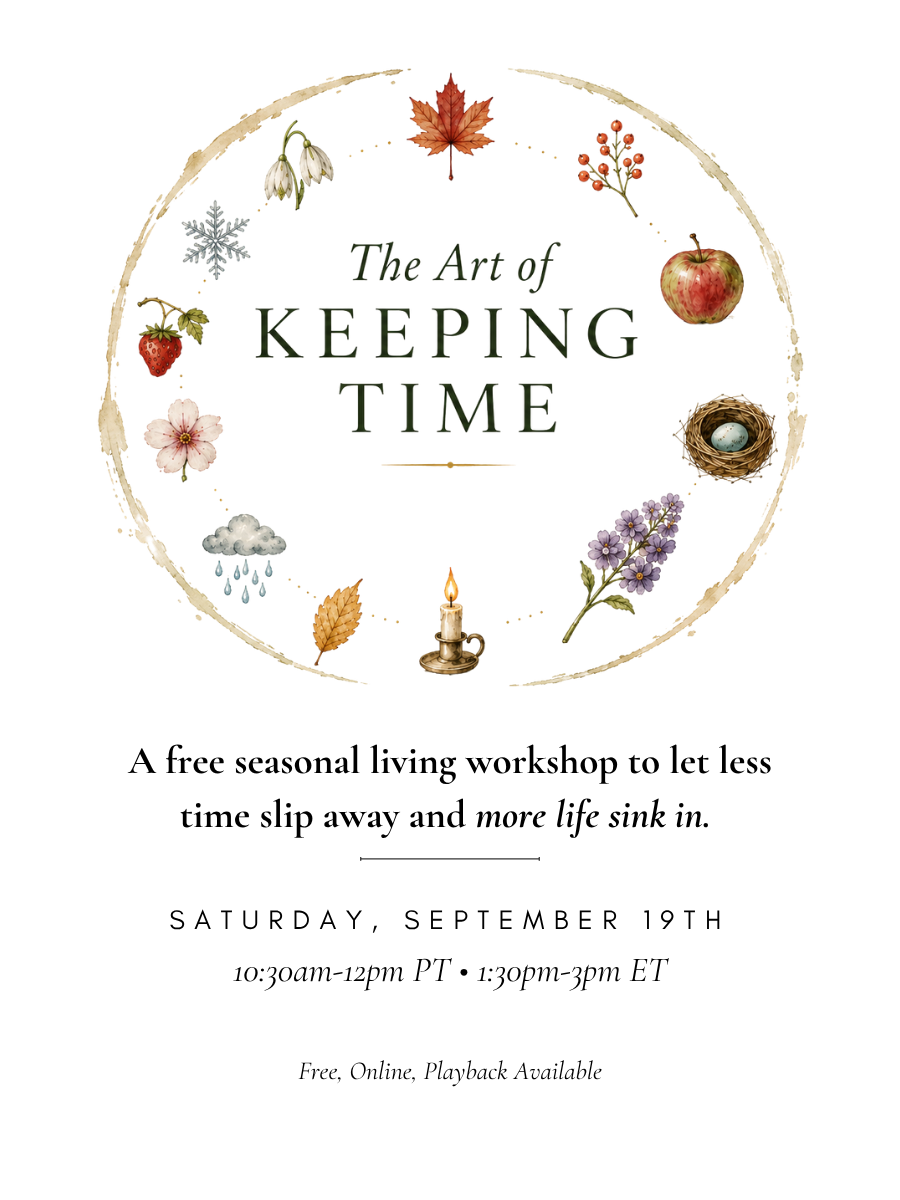
The Art of Keeping Time
A free seasonal salon to feel less like time is slipping away and more like life is sinking in.
Saturday, September 19th
10:30am PT • 1:30pm ET
Playback available
-
How to Slow Down Your September
Hello, beautiful beings, and welcome to today's episode on how to make September go by a little slower.
So at the time of this recording, we have just sauntered past the Labor Day marker here in the United States.
And every September—maybe you can relate to this—there's this excitement of the light starting to change, and these little red-tipped leaves on the trees signaling that autumn is right around the corner.
And maybe you get that back-to-school feeling, and you buy a new notebook to start off this season.
And then all of a sudden, you look up and it's Halloween or it's Thanksgiving, and you wonder: Where did all that time go? I had all these plans for all these things that I wanted to do.
And this is a really common experience, for time to feel like it's slipping through our fingers, when we live in a time in history that is so immensely disconnected from the seasons and from the senses.
So for most of human history, how our ancestors tracked the passing of time was through their senses: through the type of food that was on the table, and the quality of light in the morning, and subtle shifts in temperature.
And now we tend to track time through little linear boxes on a page, or through digital numbers and seconds on a clock, which are really helpful for quantifying time, but are not as helpful for actually experiencing time.
Because when we say, "Slow September down a little bit," we're not actually talking about speed.
What we're talking about is making your days feel more distinct and making your moments imprint into your body, so that September isn't just a long string of 30 days added to the annual register, but it's a month where you have tasted and touched and felt and breathed life through your body.
And today's episode is inspired by a free event that I'm hosting on September 19th, which, if you're a newsletter subscriber, you've already heard about in this week's email.
It's a seasonal living workshop called The Art of Keeping Time, and it's about how to make life feel less like it's flying by or slipping through your fingers, and more like it's sinking in through the seasons and through the senses.
And some of the things I'll be sharing are why time always feels so scarce—and who benefits from that belief. Hint: it's not you. There are people benefiting from that belief and that consciousness, but it's not you.
And how to write a new story in how you relate to time.
We'll also talk about some of the seasonal anchors that make your days feel less like they all blur together, and make them feel more distinct and more memorable.
And then we're going to make something with our hands.
Everybody, I'm going to share with you a creative practice that I do almost every single day to close out and mark my days in beauty, and to make the days, again, not just a list of what I did, but something that I can see and I can sense and I can savor through a creative journaling practice.
So it is free. It is fabulous. I am so excited for it. It will be recorded.
So join us at marylofgren.com/time to reserve your seat, or click the link below this episode.
And I'm so excited to gather around this autumnal fire with you and share with you some of the things that have completely changed the way that I relate with time in this free workshop.
So, see you Saturday, September 19th. marylofgren.com/time.
And so where we'll begin today is where all things begin, which is with your relationship to time.
And I say that all things begin with relationship because I imagine you know what it's like to be at a diner waiting for a friend who's always late, and you get a text ten minutes late: "Sorry."
And at 17 minutes, you're sitting there tapping your foot.
And that's one experience of time.
You might be on a massage table and you've booked a 15-minute foot massage, and you lay down and it's so juicy and yummy and relaxing.
And then before you know it—oops—time's up.
And so: same quantity of time, very different quality.
And when we think about time and the passing of our moments, the way most of us have been taught to relate to time is as something linear and quantifiable.
You know, there's this linear track of: Am I moving forward? Time is running out. Have I accomplished everything I should accomplish by now? I'm getting older.
As if time is this match that's just burning down that we have to race against.
But when we look to nature and the seasons, seasonal time is circular.
Rather than time always running out, time actually comes on back.
You know, if you think about how many Septembers you've experienced, how many autumns you've experienced, all of the autumns that are maybe to come.
And in my office, I have this beautiful art print of a fire on a starry night, and it's a painting by my friend Joe.
They have a studio in Marshall, North Carolina, called Abacus Corvus.
Oh my God, y'all, it is this company—well, I don't know if it's a company—this community, this little witch hut in the woods they've got going on.
It is some of the most gorgeous art, and it is so meaningful. And they also have an oracle deck, so I'll definitely pop a link to them in the show notes.
But this particular image, you know, it's again got this beautiful fire on a starry night.
And inscribed in the sky is a small piece of text that says, "In changing we are held by what has always been."
And I just want to let that sink in for a moment.
In changing, we are held by what has always been.
And so that's our first gem.
In order to shift and stretch the quality of time that we experience in September, where that really begins is with our relationship to it.
And so seeing September, rather than a final stretch before the end of the year where you gotta cram it all in, seeing it more as a stop on the wheel of time that you have visited before and will visit again.
Our next gem is the savoring of firsts and lasts.
So September is this really unique transitional time where change is happening in contrasts.
You know, August, it's pretty clear that it's still summer. And in October, it's pretty clear that it's now fall.
But September—and this is true of equinox months—we have the autumn equinox happening in September.
Equinox comes from that word equal. You know, so two halves: half autumn, half summer.
And I experienced this just today, where often I walk Little Man, my little Chihuahua, when the sun is just starting to dip down near the San Francisco Bay.
And there's a chill in the air and, you know, you can tell that the temperature is dropping.
And today we did our walk in the middle of the afternoon and it was so hot. So hot.
My face was a tomato.
Little Man, I had to carry him for half the walk because he gets overheated. Well, maybe I'm just a helicopter mom and I think he's getting overheated.
But, you know, his tongue is lolling about and he's panting like he's dying.
And, you know, I've been getting so excited for autumn and apples and pears and autumnal fruits.
But when I got back, there was a white peach in the fruit bowl and it was like, oh yes, the refreshment.
And it'll probably be my last white peach of the summer.
And so I got to really savor it.
And savoring these changes and transitions is one of the ways that you can help make time stretch a little bit in September.
So, you know: last peach, but first Honeycrisp apple.
Maybe you have your last read by the pool or by a lake in the afternoon sun, and then your first read of a book beneath a blanket.
Same spot, but different temperature.
There's that last sleep with the windows open, and then that first sleep with the heavier blankets.
And so again—and this is something that we'll be exploring on a much deeper scale at the Keeping Time workshop—but the senses provide these seasonal anchors where our bodies understand the passing of time, instead of just our minds tracking it on pages on a calendar, or what seasonal delight is being presented at the supermarket at the end of all the aisles.
You know, if you go into a pharmacy right now, you'll see tons of Halloween candy and Halloween decorations.
And that might tell your body, oh, it's autumn, it's fall. And how did it get autumn and fall already? Oh, the year is ending.
And friends, that's exactly what capitalism wants us to think and wants us to feel around time.
But your body has its own metronome of the passing of the seasons.
And allowing your senses to savor these firsts and lasts of the seasons is a way that you can reclaim your own experience of time, rather than feeling like it's this thing outside of you that you have to wrestle and handle.
And the final gem for slowing down your September is savoring some September-specific simple pleasures.
So that first pear that really tastes like a pear with a wedge of salty cheese.
That first time when you need a fleece or a cardigan in order to leave the house.
Dahlias at the farmers market. September is really dahlia season, late August, early September. And God, they are just dripping with beauty and belong on your kitchen table.
Heirloom tomatoes that petition their relevance through being overly ripe at the farmers market or in your garden.
That shift from iced coffee or iced tea to warm coffee and warming tea.
And then finally, having a new experience.
You know, September is that back-to-school time, and these equinox times—spring and fall—offer our bodies a real reset.
And so as you come to the end of the year and you start a new season, join us at Keeping Time, because you're going to learn some amazing new ways to relate with time, to mark time, to sense time in your body.
And imagine what it would be like if you could measure the rest of the year not by how much you get done or how much you accomplish, but how deeply you savor this season.
And that's exactly what I'm going to be showing you tools and practices to do in The Art of Keeping Time, September 19th.
Thank you so much for listening today.
As always, if you enjoyed this episode, I would be so grateful to hear from you in a review or in a five-star rating.
And I will see you in our next episode.
Bye for now.