Episode 209 : Ned Buskirk on Grief, Beauty, & Living As the Heart


About six months ago, a beloved friend invited me to an open mic.
"It's all about grief and death!" she said.
As someone who sometimes wishes I had a t-shirt that says "only wants to talk about death, religion, sex, and politics," I bought a ticket immediately.
So on a cool December night in San Francisco, I descended the stairs into a basement performance space and took my seat.
I was unsure of what to expect, but braced myself for something somber.
Then Ned Buskirk bounded onto the stage wearing a Charlie Brown Good Grief t-shirt. Through leading us in vulnerability, tears, jokes, storytelling, and a deep reverence for the human heart, he transformed the small performance space into a boundless ritual space, and the whole room exhaled.
Ned is the founder of You're Going to Die, a wonderful non-profit that holds space for grief and gratitude through expression and creative conversation about our shared mortality.
That night, I experienced what it truly means to Come to Our Senses: to wake from the trance of separateness, and be cracked open by the beauty of our shared humanity.
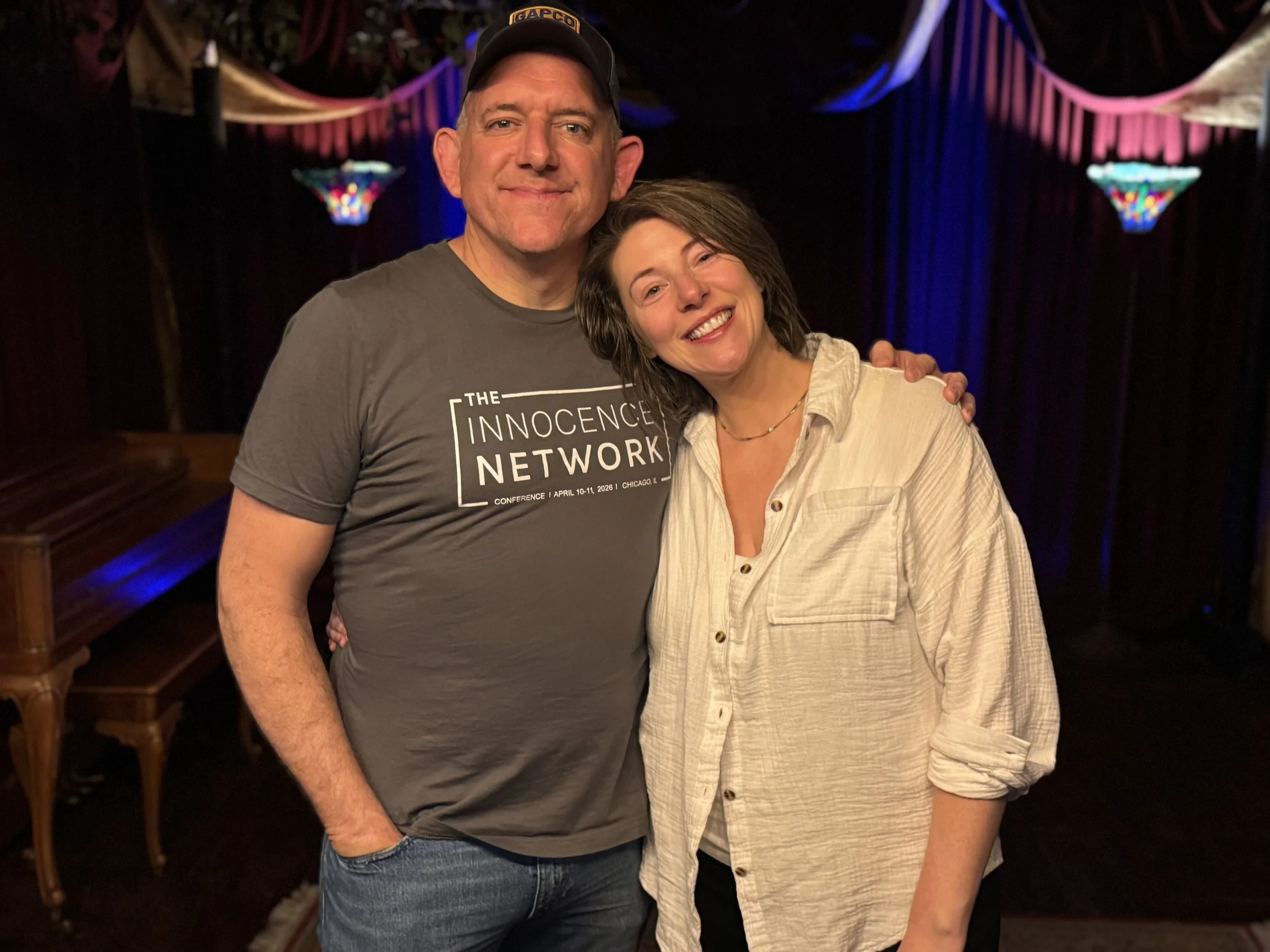
Mary & Ned at YG2D’s Open Mic
Here's a few gems you'll hear in our conversation:
How I went from armored and closed off to openly weeping
Why a room full of grieving strangers can sometimes feel like a party
Grief collages, horse magazines, and other surprising portals to the heart
Why "live every day like it's your last" can leave you feeling worse — and what turning toward genuine aliveness actually looks like

LINKS FROM THE SHOW
Learn more at yg2d.com
Heart Healing Support Kit: A Balm for a Broken Heart
Ned Buskirk is the Founder, Podcast Host, Facilitator, and Executive Director for YG2D – more commonly known as You’re Going to Die – a 501(c)3 nonprofit bringing diverse communities creatively into the conversation of death and dying, inspiring life by unabashedly sourcing our shared mortality. YG2D offers a free creatively conscious mortality podcast, monthly live communal grief and gratitude open mics, medicinal community concerts, and grief and healing writing workshops. He facilitates a suicide prevention group in San Quentin with YG2D's prison program, ALIVE INSIDE, hosting creatively connecting open mic space and workshops. Our prison program has led us into CDCR facilities throughout California, multiple prisons in Ohio, and [in collaboration with orgs like the Innocence Network and the Ohio Innocence Project] to work with our exonerated community, supporting those who have been wrongly incarcerated, along with the innocence projects and legal teams that free them. The YG2D hospice and music program, SONGS FOR LIFE, supports musicians meeting with the dying to play and create music inspired by their lives and experiences. Buskirk also facilitates creative space for cancer patients with UCSF’s Art for Recovery, including workshops online and at the hospital bedside, offering a chance for healing through creative self-expression and listening that lets the patient be wholly and fully witnessed while facing what is often the hardest time of their lives. - https://www.yg2d.com/
-
Mary
[00.00.02]
Hello beautiful and welcome to the Come to Your Senses podcast. I'm your host, award winning certified feminine embodiment coach, licensed esthetician, and enthusiastic foster dog mama to animals across the land. Mary Lofgren Here we explore how to bring more richness, radiance, peace and pleasure to our lives, homes, and hearts through the joy of beauty, the wisdom of the body, the warmth of connection, and the splendor of the senses. I'm so glad you're here. Pull up a pouf and let's dive in. Hello, beautiful beings, and welcome to today's episode, which I'd love to start with a story. So a few months ago, my good friend and housemate Bridget. Invited me to an event that was a open mic called Grief and Gratitude, put on by an organization called Your Going to Die. That is an organization that supports people to be in conversation around death and dying in a creative, alchemical supported way. This is my own description of the organization, somewhat influenced by what I found on the website. But just from what I've experienced, that's the best way I can put into words something that feels impossible to describe, which is the power of coming together for these open mics and to witness other human beings in some of the most challenging and yet most cracked open to beauty moments of life. And after my first experience of this open mic, I contacted Ned and just said I would be so grateful to have a conversation and to share your work with my own community. So You're Going to Die is a non-profit. They have multiple programs, including Alive Inside, which is a prison program where they bring their open mic experience to the incarcerated population across California. There are hospice programs, cancer patient programs, and they have wonderful merch if you go to their website, which is why 2D, that'll be placed in a link below this episode, as well as just simply the opportunity to donate and support such a beautiful, meaningful, healing community of creative souls that are truly doing love's work in the world so you can learn more about them and donate at youtube.com. And with that, let us now dive into our gems with Ned Buskirk. Hi. Ned. Hi. So excited to have you here.
Ned
[00.03.17]
Thank you.
Mary
[00.03.18]
I've been to a few of your grief open mics at the Lost Church here in San Francisco. And there's this funny thing that happens. Where? Well, the first time I was nervous, you know, and, like, when was.
Ned
[00.03.33]
When was that? This was what led to you coming
Mary
[00.03.37]
back? This was a couple of months ago. And my housemate, Bridget, um, she volunteers with you guys sometimes just to work the merch table. And, um, she was like, there's this event and I think you'd really love it. And, um, and I think I came in the first time kind of armored, you know, of like, okay, we're going in. We're talking about grief and loss and here we go. Mhm. You know, and then you come on stage with your good grief t shirt on. So
Ned
[00.04.06]
you must have this is a December ish event that you can't say.
Mary
[00.04.10]
Yes. Yeah. Yeah. Exactly.
Ned
[00.04.11]
I could year I could wear it year round but you just hung it up. I know I was like, I wonder if he wears the shirt every time because it would be so apropos. Yeah. All right. Um, and I've been back to other events and. You know, what I notice is, like I come in with the kind of raincoat of San Francisco traffic and finding parking and, you know, getting a beverage and sitting down and everybody's twittering and and then you come on stage and you open up the space, and you do so with this beautiful blending of tenderness and vulnerability, while also holding this buoyancy of the absurdity of being alive and all that we hold. And it's like, what's so interesting to me is that I feel this kind of like hot tub of relaxation happen where this thing that I'm not even aware that I've been trying to outrun is, like no longer chasing me. Because here we are to just talk about it and even celebrate it. Mhm.
Mary
[00.05.23]
And so I just wanted to start there and just say thank you for that somatic experience of suspending the trance of um. Being able to outrun being human and just the healing and relaxation and ability to be that happens as a result of that.
Ned
[00.05.51]
Thanks, Mary. That means a lot to me. And I'm wondering and you could say, listen, I'm the interviewer, so stop asking questions. But but I, I'm feeling inclined to, to ask and and I mean it like, just say we only got so much time. I have other things I want to cover. But when you when you came into that space and you described it as maybe like a armor, you were armored. Not just like life, because I don't think just life armors us. I think sometimes we consciously do. And so Bridget says, come, this will matter. And like, it's intense and grief and all that and you're like, I don't. What is that armor? Is that like, I don't trust when I've been invited to that before, or there's too much, there's too much. I'm not willing to I'm not going to be the one to let this unknown into what's precious in mind. I'm just wondering, like if you can add more language around like the Armory for. Yeah.
Mary
[00.06.49]
Ah, I love that question. Well, what immediately comes is, you know, doing this work and having gone into many kind of personal growth spaces, it's like, okay, here we go. Yep. Topics yours, grief and death. Let's go. You know. Yeah. And kind of like the armoring and the, um, almost like Popeye muscling of, like, my ability to, uh, spar with these topics, like, uh, a puffing up of, like, my ability to be intimate. You know,
Ned
[00.07.25]
that's hilarious. I mean, just know that, like, you're armoring is you're being intimate or or vulnerable. Like, I can be vulnerable. Here we go. Let me put on the armor for it. That's. My therapist. Could say a lot about this with me and. Yeah. And and so just this, like, okay, I've, you know, I've been through many cycles of this and. What is so unique about your like? I and I like so many of the people who work with you, it's like you all bring this presence of, we're not here to get through anything. Like we're not here to take it apart and cat's cradle it and make it okay. Like we're here to witness and be in. Like the word that comes is like the sensuality of this, you know, and that's being that this has come to your senses. Such a topic that's near and dear to my heart. And I remember when my dad died. My dad died, um, he was in a bicycle accident. He was 75. And
Mary
[00.08.36]
just this, um, experience of.
Ned
[00.08.43]
There being nothing else but our senses, you know, and like, I remember, like. He was in a bike accident. He. He snapped his neck and he was pretty much in a coma. But he woke up for a couple hours, you know. And, um, my friend who's a physical therapist was like, you need to engage him. Like you need to read to him. So. And he loved horses. So I had a horse magazine, and I'm reading to him about, like, boarding, you know, thoroughbreds and, like.
Mary
[00.09.17]
And I could see in his eyes like, he knew, you know, and, like, caring for me even though he couldn't move a single muscle other than his eyelids, you
Ned
[00.09.30]
know, and, like, just that paradox. And it's it almost sounds trite, but like that paradox that, um, being intimate with death is the doorway to our aliveness. Mhm. And, you know, this is a, uh, this is the landscape that you choose to tread every day in your work.
Mary
[00.09.59]
And so I wonder if you might just like speak to that. Mhm. Um,
Ned
[00.10.06]
yeah. Do you mind sharing your dad's name?
Mary
[00.10.12]
Yeah. His name was Joe. Joe.
Ned
[00.10.16]
Absolutely. Questions what I'm going to restrain here. I'm being interviewed. But it matters to receive that. And just to kind of piggyback on the senses experience even being with you and hearing you share that story. Is a is that practice, right? I mean, it is so important to me, even when I'm on a zoom call to communicate, uh, experience of presence
Mary
[00.10.51]
and allow myself to be here, or part of why I keep coming back to this work is because, in contrast to probably most my daily living. These spaces and conversations like this in the open mic, like you attend you attended, is a chance to be only one place and to have a responsibility for that place that demands I'm not distracted or on my phone, or connected to my phone, or thinking about the past and the future. And I heard someone say recently in another interview that I heard something around the impossibility of being just in the now. And I do think in general, it is hard. And I think what you described, and I loved hearing your unique version of it, to come to the open mic and have an invitation that's somatic, feels like a really good way of describing what I feel. I'm probably more committed to with language as much as intention. I feel like always there was an element of this, but to to really even ask us, like you may have heard me say, versions of at the beginning and at the end, to really check in with our body and see how we're feeling about what we're about to experience or what we have experienced, and to know that that arrival first is such a easy and. Important entry point to that kind of communal space. To know that our first way of paying attention to one another is by checking in with how we're doing and by acknowledging, like, our fragility and maybe even how we feel when I'm host, like weeping in front of you at the start of what you thought was just going to be like an open mic on a theme, you know, which is like, you know, by now it's like, not really that it's it's something deeper and maybe more confronting in a lot of ways. And so calling in the senses and the sensuality of the moment feels really, really good to get that reflection. And it, it is a what is this container like? What is this mortal vessel feeling right now? Literally like from the tension and the stress to the relaxation to the pain, whatever it might be. And then to note that that's that vessel is holding so much, it's holding the heart. And what is the heart feeling? And it's holding the mind. And what is the mind obsessing over or what's rattling through it. And to know that doorway of ourself, that first container we address and pay attention to, is a doorway into this greater container that we share in an experience like that. Like the open mic offers. And I'm not great at, like, body stuff. You know, I think when I'm invited into, uh, a massage or some kind of somatic invitation body work, I there's a strong, like, ease with which I can get there. And that's dependent probably on the trust of who's doing the work and how they create the space for that work. And mostly I feel like I'm like, up here, you know, I'm like in my head figuring stuff out, trying to get away from the moment or just sort of fixated and addicted to like, what is the next thing? And how could I control my life by having things organized in the emails and the text threads and the, um. So
Ned
[00.14.28]
the open mic offers me that, like drop back in, in the heart is that place to, you know, that that I'm getting deep into when I open up the open mic space or any of the workshops and events that we facilitate with our nonprofit work, you know, in prison and with the cancer patients. And so. All that is to say, appreciating the question and the framing. You kind of added language to that. I hope it's okay. I take some of that with me after the day, because that feels more consciously an intention of what we can start with when we choose such hard, sometimes hard conversations about these eventualities or the things we're living through that regular daily life doesn't, and people don't make maybe enough room for. Yeah, you know, especially in community.
Mary
[00.15.19]
Yeah. Yeah. I, you know the saying, if you think you're enlightened, go spend a week with your family. Mhm.
Ned
[00.15.27]
Yeah. I think that could also be applied to like if you think you're peaceful go get a massage. You know what I mean. Right. And it's good to hear and like I notice and myself I think whenever I, I, I meet someone who does the kind of work that you do, I have this perception that it's like you don't because you work in this portal.
Mary
[00.15.57]
That you don't get email stress. You know, like that. You're so in the moment with your
Ned
[00.16.02]
people. Yeah. Yeah. And I just tell you, I mean, part of the reason why we're talking is because all this stuff exists, in contrast to the fact that there is a major part of me that's like, kind of stressed and, yeah, OCD or my nervous system is, like, highly reactive. And my regular life, I might even be like, super protected and introverted and on the defense, you know, because of how sensitive I tend to be. So. Totally. Yeah. So just to make sure we're
Mary
[00.16.36]
we're clear.
Ned
[00.16.39]
That is definitely a part of my my lived experience. You know. Yeah. Which is why I love, like, how we met. Like, we meet in that open mic space. Right? And it's like, oh, what a relief. You know, I'm not it's not that it's not hard, but it's the kind of things that demand of me, uh, presence of being that I is not common for me. Mhm. Insists on it. There's nothing. I'm going to choose over the vulnerability you've witnessed, like the nights you've attended and that I've seen for over a decade in that space, which is wild, right? To say that I've done that open mic, just that alone for 15 years, probably almost monthly and sometimes more. And to think in the kind of level of what it means to do work in the world and move on and grow success and expand programming like there's versions of that that the nonprofit has has unfolded, and the work that you're going to die has unfolded. For me and that flagship event, that heartbeat is still as strong and maybe more precious to me and important than it was when I first did it in the mission in 2012. You know, and because I know, because I need it, you know, I need it as a medicine to my own angst and my own fears and my own fixations and obsessions and distress and trauma, you know.
Mary
[00.18.10]
Yeah. And is that how it started? Like. Was it a need for the medicinal experience of grieving in community? Yeah. So I, I, I know I've named with you the, the risk I feel in telling the origin story. And then always we get to that question. It's like I kind of still need to tell you the story. And I mean, for the listeners, I'm trying to say, like, I don't want me telling this story for the thousandth time to diminish the import of it. And so forgive me if somehow my heart isn't fully in all the words, but I do hope it is like present. Um, in repeating a story so often, there's just the risk that it might deaden the import. But the reality is, the answer to your question depends on it. And it is that my mother died in 2003, and the short version of the story that connects to the answer to your question is that I somehow, at 26, really knew I needed to go and get support. And I didn't learn that from my family. I didn't learn it from my mom or my sister and my dad, or anyone else for that matter. I think I must have had friends in my community. One person comes to mind in particular, who suggested even an option for what it might mean to get mental health support around that loss. And it was a organization in Los Angeles that offered. Inexpensive mental health support, and I joined a bereavement group for loss of a parent, and I was in that group for about a year. And there's ways that my experience in that group definitely influence what I do now, for sure, and what I started doing more and more of once the open mic opened up into all this other work with the nonprofit. But it was that place, right, that we share in the open mic space as the best example of it, where you go and you sit in a circle of community who have such unique versions of something that lets us witness one another. Well, just to sit in a circle of folks specifically who have lost a parent, whatever the story is, whatever complex relationships they had, like this was hugely important for me to get that space led by a really skilled somatic and mental health professional. And I mentioned that because that was like an early time when the work I started to do out of that group was one on one with that, that professional. And and I remember in circle what would happen when I would talk about my mom dying,
Ned
[00.20.50]
how much my body would kind of all up like I describe, like the heaviness and the words, you know, and the emotion is just like. Kind of repressed. And, uh, what's the word? Kind of, um, chunky, you know, coming out in stutters and no flow to it. And I remember her asking me to check in with my tummy, you know, like asking me, how's your stomach feeling right now? That was an early version of what I know you understand well, matters to say in the somatic work what is going on in your body while you're feeling this and talking about it. And so I continued my healing with her one on one, where I'd go in for a session and not talk much, but lay on a table and have her do not Reiki but energetic work around parts of my body, especially parts that I'm sure commonly connect to grief and loss and stress. Um, hugely important. And then, you know, in mental health, some people keep going to their therapist and maybe stay in groups for years. But I have an experience that there's an ending for me. It's not forced often. It's just a readiness that I feel it's time to move on. And often I'll find another therapist a year or 2 or 3 down the road. It's just clear to me that that is a time that needed to end. And it did. And.
Mary
[00.22.16]
That felt healthy. It felt like the right decision. But then I'm in my 20s and going into my 30s, still holding this loss that's changing me today in my 40s, still impacting me with revelations and feelings and memories that maybe I haven't thought about in a while. And birthdays and anniversaries and death anniversaries. It's just ongoing and mostly in life. After those mental health support contexts. I was just holding that alone. I might find like a poem to write about it, or a friend to name it with drunkenly one night. Yeah, or meet someone else, maybe. But at that age, like most of the friends I had, hadn't lost their mom. Yes, many of them still haven't. So it ends up being this thing that defined it, defined my lived experience more than anything, and I wasn't talking about it. And so to answer your question right, it's this moment. Once I moved to San Francisco, I have this event space that I've started. It's definitely a mortality influenced, creative, expressive space, right? It's a place to share from the fact that you may not be alive tomorrow. But once my mother in law died in 2012, that loss brought up all my mother loss again. And the first open mic, which had been happening for months by that point.
Ned
[00.23.44]
I was really clear of what I needed, and that what I needed was to talk about my mom and talk about my mother in law, named them, talk about their deaths, and talk about their lives and talk about my mortality. And it felt crystal clear to me that that was the space to do it in. And lo and behold, in the months to come. Once that venue we found and the clarity I had around what the job was for me there, which it was a beginning of the facilitating space for me.
Mary
[00.24.19]
Seeing people line up and sell that open mic event out, you know, not as a measure of like look cool, we're successful, but more as a oh my gosh, look how many people need that, you know. Yeah,
Ned
[00.24.31]
totally. And it was medicine for me. And it was medicine to share with others.
Mary
[00.24.38]
Yeah.
Ned
[00.24.39]
And couldn't have given me what it's given me without people being clear, like you were coupled with the right invitation to know it was a space you were willing to say yes to. Which still astounds me that people choose the Cancer Patient writing workshop. The Grief and Gratitude open mic in prison, the one open mic you went to that we do in San Francisco like to have people. It shouldn't be a surprise by now, but it still just feels significant to name. It's like you're my people, like you. You say yes to this like it's a big deal.
Mary
[00.25.17]
Yeah, well, and I, I feel like. You know, I love the word hunger and all of the ways that hunger, like the suppression of true hunger, gets misdirected in life. And I think, you know, I know that like just seeing the appetite of people lining up outside the lost church and getting tickets in advance and, you know, it's like there's a deep hunger there to talk about it and to hold it in this, like chrysalis of beauty that is created when we're not necessarily like going to a therapy group to try to work through this and then become more functional, like it's literally like a party to uplift it. Mhm. And I've heard you say grief is love with nowhere to go.
Ned
[00.26.26]
Mhm.
Mary
[00.26.28]
And something I so appreciate about these events is the role that creativity plays in giving that love somewhere to go. Mhm. And I remember I did a grief group after my dad died. And one of the assignments that we had was to create a grief collage. And the therapist had printed out, you know a lot of like tormented images. And that was so helpful because I had a lot of conflicted grief when my dad died. You know, there was like this deep sweetness of honoring and missing and then also this, like, really unfinished resentment towards my dad, you know, that I really had to, to work with. And I don't remember anything else from that grief group.
Ned
[00.27.24]
But they had they offered up other images other than the torn ones. Okay. All right. They're like forcing your hand. Oh, but yeah, you were just, like, glad that they included the. No, it's not complete or. Yeah. Uh, in turmoil or suffering. Yeah. Totally. Totally. Yeah, they did definitely offer a holistic spectrum. Good.
Mary
[00.27.48]
And that was really helpful because I
Ned
[00.27.49]
had both. Yeah. That's so good.
Mary
[00.27.51]
Yeah. On the collage and, and and I remember nothing else from the group but that cathartic experience of seeing this tangled ball of yarn inside of me, neatly arranged outside of me, in image and in beauty. And I wonder how has this work and and, you know, it's like I even hesitate to say this work because it's your life path, you know, like it is work and it is a body of work. And yet it's also just your lived experience. And I wonder how has your definition or understanding of beauty
Ned
[00.28.34]
evolved
Mary
[00.28.36]
through this work? Hmm.
Ned
[00.28.45]
Well, first of all, I feel it's important to say I don't know if and if I did say it when I said grief, uh, is love with nowhere to go. I I've heard that before. I have quoted it. Yeah, but it matters to say, like I, I don't want anyone out there that heard it somewhere else. Right. I I'm it's not my quote. I have heard it elsewhere before and I want to articulate that in a way I think connects your question. My feeling that I don't while there may have been some point, maybe the open mic where I said it, I was like, this is true, everyone. Maybe now I don't feel that way. And that is like grief for me is the like. Question of where the love you know needs to go. You know, I think that's what grief is demanding of us. And I feel like that moment you're describing with a collage, is that right? It's like, oh, oh, okay, here is where the love can go. And I understand it's a collage and a group, you know, it's not an ongoing, you know, um, practice necessarily, but that it was a moment where it found its place and it was in front of you. And I think about that in our especially writing workshops, which is usually the craft that's invited. And the work I do with cancer patients especially, but sometimes with our writing workshops online and, and in prison. And it is that where can you put that thing and get it out and down in front of you and what you're describing? I would have felt Mary sitting with you if I was facilitating that and hearing the reflections you just shared with me. This is what I felt about them, that it is beautiful. It was beautiful to hear you describe that, and I imagine it would have been really beautiful to sit with you in that circle and see it in front of us.
Mary
[00.30.31]
My feelings about beauty that connect to this journey for me are the answer to why I keep doing it. When people say, how can you keep making room for that much? That's hard. How can you do all of that? And my answer in the last year for sure, has commonly been because of what happens when we do that. Like you witnessed. And we shared at that open mic. And I see every month. That's just so wild to me. They're always different, okay. And it's always a different kind of conversation. And sometimes it's not celebratory about life. Sometimes it's like really intense and there's a lot of trauma and upset. But always every time there's beauty that gets expressed and it's moments that can be accented by the fact that the person talking is talking about how they wanted to end their life and tried to ten years ago, at a moment at the last open mic where someone shared a a version of that. To have that moment, to be awestruck by witnessing something that's existing in the wake of something that almost happened and it would have taken the moment away from us. That's such a great version of like, what it means to see beauty unfold out of darkness. And so I think my answer to your question is just my relationship to beauty has been emphasized and magnified by choosing what is ugly in a way. You know, like once dark and disturbing and upsetting and hard to face sometimes the trust I have that includes resistance and torment. Getting named like your collage wasn't just sweet and pretty, but there's something beautiful about you choosing torment as an expression to even hear a little version of that from you about your dad. It's complicated, and in that complexity, it's beautiful and enlivening because it's not simple and it's not flat. It's multidimensional, and it calls forth many parts of me. Even with you in this conversation. Like what we get to share. The enlivening that happens
Ned
[00.32.50]
is how much people name in a space that's facilitated. Well, that's not all sweet and funny and good, but there's so much that we make room for. It draws forth more of our being in our spirit and our soul, maybe even even a better word, or a really more important word for me in this work. And that's especially from Francis Weller's influence. You know, when the soul is asking you to look at things point like, this is the thing I keep wanting you to pay attention to. To have that in a community circle. It's one of the most beautiful experiences of my life. Like, I want to go and travel Mary to many parts of the world, and there's a part of my feeling of being alive that the way I go on an adventure of traveling is in this work. Like, that's where I'm, like, blown away by what I get to witness and and the risk of it, too. You know, like that. It's it's not always easy. And that's enlivening too. You know, like, I'd rather that and and think I probably get the same results in my life and well-being and my awe of what it means to be alive, as I would get if I decided to skydive, you know, or climb Mount Everest. Yeah. You know. Totally.
Mary
[00.34.15]
I would so and that that leads me to my next and and final question. But another question just popped up. I'll put a pin in the skydiving piece. Um, I remember after that first event, there was just this line of people who wanted to talk to you. Mhm. And I, I was, I was waiting for the bathroom or I was waiting for Bridget. She was in the bathroom and I felt that, you know, you were in that process of receiving people and having been a facilitator, there was a part of me that wanted to go up to you and say, like, is there anything that you need right now? You know? Yeah. Because it's like, in a way, I just in that moment I saw you as being this kind of rock that these people could crash against, you know, with some of these deep things that they've maybe never shared with anyone. And I wonder. I mean, the real question is like, what's that like for you?
Ned
[00.35.27]
Well, thank you for how that felt to you and what you wanted to offer me. I think there's a pretty healthy balance of folks understanding versions of what you just described about what happens. And I actually don't like, mean to make it about me. If I could just like, zoom out a little bit and acknowledge what you said. Like, you know it, right? When we facilitate space a certain way, when we do it with others in our life personally, there's an energy exchange. There's offerings in both directions. What does it mean to matter to someone else who says they need you? And how important that is in a culture that's constantly. Questioning that, you know, with whatever way it does. Social media just alone, like you're. Are you worth it? You know, prove it. Yeah, yeah. So to to just get that moment personally is so affirming and. I am thanking you for what you sensed and noticed and wondered about, because I feel that from the community, when you have 70 people in a room doing what we did, there feels like equal doses of the people are like, he needs a hug, as there are the people that are like, I need him, you know, and I need more of that. And or I want to thank him. And so I feel usually that balance and that understanding and it.
Mary
[00.37.05]
Is usually one of the moments in my life where I feel more open than ever and in very strong and grounded,
Ned
[00.37.20]
clear ways that things change. I'm experiencing with community like that is two ways, and there's a great okay ness about it.
Mary
[00.37.35]
I love that, and you know I won't. I know we only have so much time, but I want to say, like, that's not always the case. Yeah. Like that. I also have people that reach out to me online, and I've had to do some work around boundaries of what it means day to day to day, week to week, month to month, all year long. To say I'm someone who wants to do this, and I want to be that community member. And there's a limit when you, I guess, are some version of a leader in that context for me to how much I could do that regularly.
Ned
[00.38.14]
Totally. And the open mic events are major catharsis for me, and really good at grounding me and binding me to what I know matters more than anything. And I don't know that I like being with death constantly and thinking about it constantly. Like I don't know that I would survive that all the time. You know, so there is the conscious needs, kind of like turn some stuff off. And I do need to boundary myself, and I do need to redirect and our team growth with an organization and, and meeting folks like you, Mary, and trying to do a little better effort to connect, especially mental health folks. But like community to other community like that feels more important than ever. Because it's not it's it's yeah, I want to be careful how I say this. I just want to I want to say. That is so important, right? That what we shared at that open mic is something we all can take some responsibility for when we leave that room, that we all can do versions of that in the world and that we were needed.
Mary
[00.39.24]
Mhm mhm mhm. You know I really appreciate it helps me understand because when you start us off you're really setting the tone. And when you just get up there and start weeping, you know, like it is um it's, it's very different from facilitating as in like I'm gonna take you through a process now, like you're literally you are in the process with everybody else. And I appreciate that distinction. Um,
Ned
[00.40.03]
that that there is truth to that, that sometimes I'm operating in and with the wound, um, mine.
Mary
[00.40.12]
And I think mostly like I think a good facilitator facilitator should be doing. I am working with scars and I don't have access to the quote. And maybe I'll email it to you and you can add it in like the intro or something. But there's a beautiful quote that I just received from one of my interviews for our podcast that really clarified that to me. What does it mean to cry on stage and sometimes cross over into, like, I'm feeling a wound like, this is real and I'm like, falling apart and still knowing in the open my context. Yeah. Like there's a way that works. There's a way that, yeah, we're doing something together. And I want people, I want to be be sharing that with people. And. Right. The
Ned
[00.40.56]
risk of centering myself in a space that I'm like leading and opening, which is dependent on over the years. Me like not drinking like I used to drink when I first did the open mic. And so there's commitments I've needed to make around what does it mean to stay grounded and clear and facilitating and leading and hosting from like, the right parts of my human experience. Right. Um, yeah. Matter mattered to me to clarify that.
Mary
[00.41.21]
Yeah. Thank you, thank you. And the skydiving question, and this is the last question I'll have, is, you know, we hear a lot in kind of the zeitgeist of like, make the most of every day. And that kind of hot tub relaxation feeling that I described at the start is like when I'm in the you're going to die spaces and just really, you know, listening to your podcast, interacting with the organization at all, there is this feeling of like, oh, I lived today, you know, and often culturally I live today is, I think, conflated with a lot of intensity. Mhm. Like do the scariest thing. Tell the person you're in love with them right. You know. Right. Right, right. And like, I like just that leads to so much self-doubt and self-loathing at the end of the
Ned
[00.42.23]
day. Yeah, yeah. You know. Yeah, yeah. Guy did not skydive today. Another day I missed it. Yeah, totally. Well, yeah, I mean, it goes back to that. What I was saying, like the adventure for me is what we shared at that open mic, you know, like the cancer patient workshop I facilitated this morning. And in that workshop. I feel like I know. I feel like I'm ready to answer your question. That I let you finish. It is. This was really, really, really sweet for me to receive, and I'm so glad I have a place to share it so immediately. This cancer patient was writing about
Mary
[00.43.04]
what it means to be discouraged and to feel defeated. And they're facing that kind of diagnosis and treatment right now, right? It's just like it's all a question. And it and you just don't know
Ned
[00.43.20]
this could end their life. And what can they do for that not to happen. It's that kind of thing. Right. And to feel the body
Mary
[00.43.31]
not working and to not know what to do on top of everything that's being done to you and your body, to somehow keep you alive, to feel that experience of discouragement that I can't even imagine, like I know a discouragement. I don't know it in that way, but I learn about it in, in these workshops. And this person was sharing about that and they kind of broke down the.
Ned
[00.44.00]
Language around courage and discouragement. And, you know, a root, a root word encourages, like connected to the heart, you know, and what they clarify and I think is so precious to me. And and it's a reflection of these spaces that we're talking about. And it is to know like the courage. Right. We think traditionally is you had courage to get up and jump out of that airplane. But their point was that courage is to be the heart, to speak from the heart, to share from the heart, to be honest with, with what's raw and real and true about the heart. Like that's courage to me. So to sit in a room where people are using that kind of courage with each other, which does absolutely include a version of skydiving for some folks, you know, people get up on that stage and they say, and it's often the case, I've never done this before. I've never told anyone this before.
Mary
[00.44.59]
Like how
Ned
[00.44.59]
often I've heard people stand in front of an audience and say. In front of a community and say, I've never said this to anyone. But to just name like courage, to declare how broken you are to to to declare that you're that you're thinking of ending your life, that you've been struggling with that.
Mary
[00.45.29]
I'm not anyone out there that sky dives regularly. I just want to say like, you're awesome. I definitely am a person who was afraid of standing on a skateboard and like late on it, I literally that's probably was more dangerous. But like, I was like not standing on this thing. It was no way in hell I'll lay on it. That's the most I do. And just roll down the driveway on my belly. I was like, I know there's a part of me that's terrified of getting hurt and dying from those kinds of ways of being in the world and, yes, like to feel the enlivening you felt at the end of the open mic. I think that's because of the kind of courage we were in the presence of, including our own, to choose to be affected, how many times we were in all the complicated ways we were when we were together at that in that evening.
Ned
[00.46.17]
Yeah, I say that a lot. It's like this evening. Doesn't depend on all of you getting up and sharing. It actually depends greatly in equally on how much all of you out there are willing to be affected. Like that kind of vulnerability too. Yeah. And boy, isn't this work. Just a bunch of questions mostly. But I think when we really, like, let ourselves fall apart or let go into those questions together with one another, what emerges for me is reliably life changing and especially deepens my experience of being alive. Without a doubt.
Mary
[00.46.54]
Yeah. Living as the heart. And really take that in and taken that with me of like, you know. Yeah, it's so funny, that circular thinking of like, am I, am I doing it? Am I making the most you know. And that to me is really what come to your senses means it's like awakening from these trances. Of lack.
Ned
[00.47.26]
Well, I mean, just to connect it to your father in that moment. Like what else? Yeah. You know, like, you're not going to take him. And I don't mean to, like, keep using the skydiving reference jokingly, but, like, that wasn't an option. Yeah, but what was the courageous thing to do was to do what was needed. Yeah. Which meant, like facing one of, if not the most tremendous loss of your life. I don't know all your story, but I know that it's up there. Yeah. And choosing to be present and also choosing something in most contexts that's seemingly mundane, but that you knew that it mattered, like life and death.
Mary
[00.48.03]
Yeah. And just to say, and echoed the sentiments that I feel like you you heard. But the the belief I have in the levels of consciousness of human being to know how much your dad was with you there in ways we can't understand and maybe ever know, at least while we live in these bodies. And.
Ned
[00.48.25]
Yeah. In this lifetime. Like what? A gift.
Mary
[00.48.30]
Yeah.
Ned
[00.48.32]
There's a there's a knowing. Inside of me and told people in in my personal life this but not. I don't usually talk about this publicly much, but when the accident happened. Like, I, I feel I have a belief that he had a choice to go or to stay knowing that he'd be staying temporarily. But it's like he loved us and cared for us so much that like, even if he had to go through that pain like he wanted us to be able to say goodbye, you know? And, um, I appreciate you saying that of like, you know, because, like, in that situation, it didn't really seem like he was there. But I appreciate your knowing of that edge. And, um. Really. Helps my heart feel at home.
Mary
[00.49.30]
Yeah, man. Thank you for living as your heart and the way that you inspire so many. Myself included, to do the same. And will include all the links and all the ways and you know. Just very grateful for you. Very grateful for your presence here. And can't wait to see you at the next YG 2D. And I want to place a penny of commitment in the fountain of putting my name on the list to
Ned
[00.50.01]
share. Hey, there you go. Once you say it, I know it's like you already jumped out of the plane. Just, you know,
Mary
[00.50.09]
like that bravado of like, oh, I'll show you how intimate I can be. Yeah, well, I haven't put my name on the list.
Ned
[00.50.15]
Yeah, that's a wrap. All right. I look forward to that. Awesome.
Mary
[00.50.19]
Yeah. Thank you so much. So
Ned
[00.50.21]
much, Mary. If you're craving more of this kind of slowness in your daily life, I invite you to come unwrap a bonbon of a practice. It's a free five minute velvet reset to lead you back home to your body. Whenever your thoughts are spinning, your shoulders are tensing, or you just need to reconnect to the compass within yourself. It's waiting for you in the show notes or at Mary Lofgren.